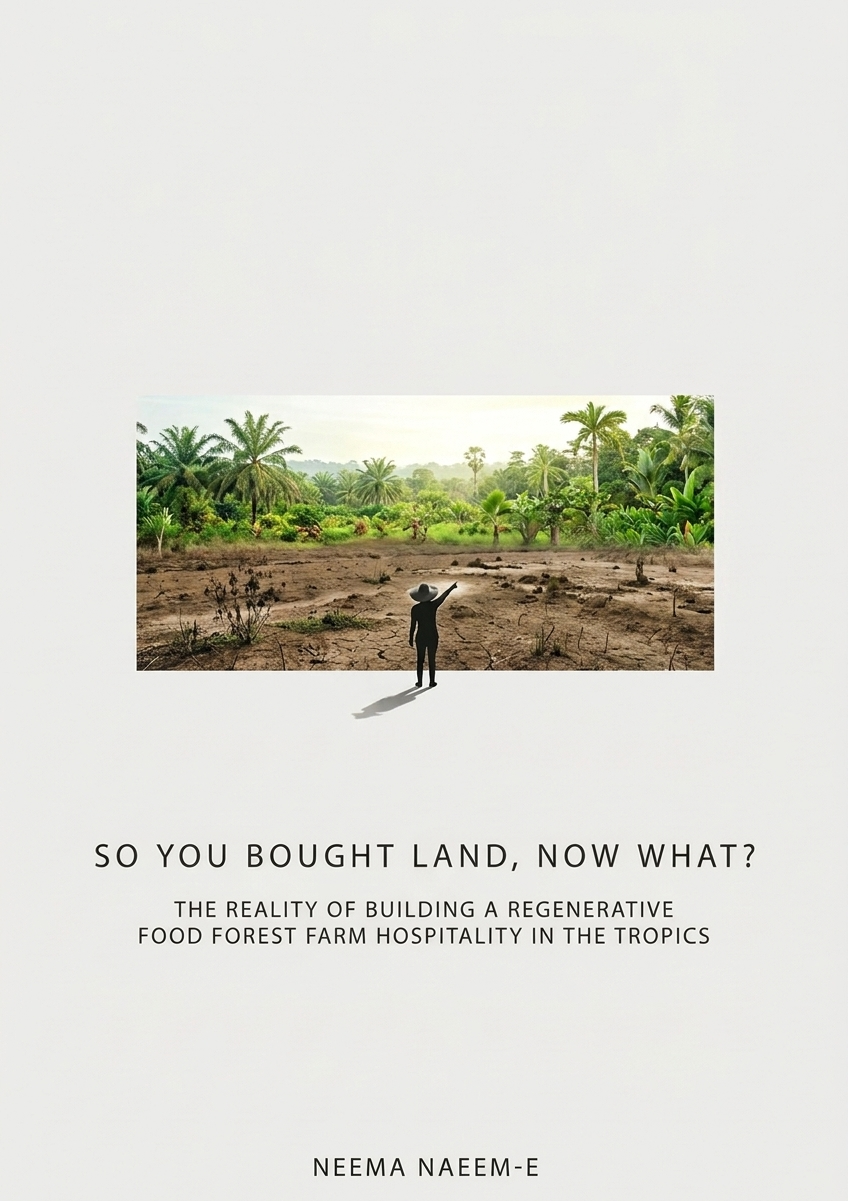
So You Bought Land, Now What?
— A new book by Neema Naeem-e —

You Bought The Land.
Now Comes The Hard Part.
Here's the order it goes in.

A plain guide to developing land in Central America: how to read the property, plan the water, cut the access, build the storage, hire and instruct a crew, and time construction around the rains, with fruit trees and an edible boundary going in first so the land is already producing while the house is still a drawing.

Yes! Rush me a copy — $20
Ebook only · Instant download

Boundary first, then inward

Most people who buy land in Central America start with the house. Neema Naeem starts with the boundary and works inward, because a building can be finished later and a five-year-old tree cannot be ordered and delivered.

If that idea lands, get the book.

The problem with buying land in Central America

You Bought the Land. Then Two Clocks Started Running. And No One Told You About the Second One.

You closed. You stood on the property. You could already picture it: a canopy of fruit trees over the path, food within reach from the kitchen, a long table under shade, the road coming in clean, guests arriving to something that felt alive.

Then everything started shouting at once. Water. Fence. Road. Power. Septic. Storage. Workers. The house itself. Every unfinished system at the same volume, and no obvious place to start.

So you did what almost everyone does. You called an architect. The drawings started. The budget began moving toward concrete and rooflines. And the land itself, the soil, the planting, the living infrastructure, became something to sort out later, once things settle down.

“I’ll do the trees after the build.”

“I don’t even know what grows here yet.”

“I planted last rainy season and half of it disappeared.”

“I’m managing this from another country through voice notes and I have no clear picture of what actually happened on the ground this week.”

If any of that is familiar, the problem is not capability. It is not a lack of knowledge about plants or construction or Central American climate. The problem is that no one handed over a framework for what happens first, what can happen in parallel, and what becomes genuinely expensive when done in the wrong order.

The Two Clocks

From the moment ownership transfers, two separate clocks begin running simultaneously on every tropical land project in Central America.

The construction clock is the one everyone watches. It tracks drawings, permits, materials, crews, rooflines, and finishes. It can be paused when cash is short, accelerated when labor is available, redesigned when the plan changes, or restarted entirely if something goes wrong. It responds to money and decisions.

The biological clock is the one almost no one talks about. It tracks rainy seasons and dry seasons, planting windows, root establishment, canopy formation, soil recovery, nursery propagation, and the slow compounding of biological maturity. It does not pause. It does not accelerate for money. A tree not planted this rainy season is still not planted next rainy season. The canopy delayed by a year is a year younger, always, for the life of the property.

Most first-time land owners in Central America spend their entire first year watching only the construction clock. The biological clock runs unattended. And the land that could have been establishing itself, becoming more capable, more productive, more sheltering, more alive, waits.

This is the sequencing problem. And it is especially costly for anyone building toward hospitality.

A room is not a destination.

A successful farm stay, retreat, or eco-lodge in Central America is not a collection of bedrooms. Guests remember paths through mature trees, fruit they picked themselves, outdoor gathering spaces that feel lived-in, food that came from the land, and the sensation of being inside something that is genuinely alive. That living landscape is not decorative. It is part of the actual experience that brings people back and generates the kind of word-of-mouth no advertising budget can replicate. But it takes years to establish. And it has to start before the house is finished, not after.

The view is also, it turns out, the cheapest part of buying land. Beautiful hillsides, tropical vistas, and dramatic coastal access can hide expensive problems: water access, soil depth, erosion risk, access road costs, dry season vulnerability, and build complexity that does not show up until after closing. Understanding what the land is actually made of, and what it needs first, changes everything about the sequence of decisions that follow.

So You Bought Land, Now What? is the book written for that exact moment: after the close, before the first mistake, when the sequence still can be set right. It covers what goes first, what can happen in parallel with construction, and what to never let fall to the back of the list just because it doesn’t show up on an architectural drawing.
The Shocking Truth About Why You're Still Stuck

The belief is reasonable: build first, plant after. That is how land development works almost everywhere. The heavy equipment leaves, somebody grades the disturbed soil, installs irrigation, buys plants, and makes the property look alive again.

That sequence makes sense if landscaping is decoration.

A food forest is living infrastructure. The shade over the future path takes time. The mango beside the guest house takes time. The hardwood boundary takes time. You can build a wall faster by hiring more people. You cannot hire ten people to make a seven-year-old tree appear next Tuesday.

So the myth costs you the one input nobody can sell back to you. By the time the structure is standing, it stands on bare, hot land.

Why Traditional Approaches Keep You Trapped

Here is the failure most owners walk into without noticing.

The architect draws. The contractor arrives. Materials eat the budget. If planting happens at all, it happens scattered across the property, without dependable irrigation, without permanent markers, without clear instructions anyone can follow.

Then the wet season arrives and the land grows faster than your management system. A clean planting site disappears in weeks. Grass rises. Vines cross. A small fruit tree becomes invisible. A worker shows up with a machete and cannot tell your avocado from the regrowth.

The dry season finishes whatever survived, because the irrigation that looked fine under four months of free rain quietly failed at the end of the line.

Meanwhile you are trying to hold all of it together from another country, through partial translations, changing crews, and one contractor who is genuinely good at one trade and has somehow accepted responsibility for the entire build.

See, I Was Just Like You…

After graduate school I spent time in Mexico, on the Yucatán Peninsula, and I remember standing under an enormous sapote tree that felt ancient. People had eaten from it. Birds had eaten from it. Shade had moved across that ground long before I got there. Whoever protected that tree when it was small never experienced most of what it became.

That stayed with me. But wanting a legacy and knowing how to sequence one are different problems, and I learned the difference the expensive way.

I planted fruit trees all around my property because I wanted a food forest all around my property. Then the land grew. Workers cleared. Nobody could find the trees. There was no marker system, no irrigation reaching them, no single area anyone was responsible for protecting.

I lost hundreds of trees. Not to climate. To organization.

I built bamboo structures I later had to take down. I had food taken from the edge of my land, yucca mostly, until I stopped treating it as theft and started treating it as information. And every one of those losses cost the same thing, which was not money.

A building can wait. A year of biological time cannot be recovered, ever, at any price.

The Sequence Revolution

The discovery is not a species list. It is sequencing.

Sequencing isn't slower. It's what stops you paying for the same year twice.

Think of it as two clocks that started the day you signed. One is loud: the welder says Tuesday and means some Tuesday, the truck is late, you changed your mind about the kitchen. The other is silent and never stops: the nursery that could have spent this year multiplying plants, the boundary that could have been growing privacy, biomass and food while the plans were being revised.

Nothing in this book asks you to choose between them. It asks you to stop letting the loud one dictate the quiet one.

Establish the Land While You Establish the Home. That is the central principle of the book, and the whole method sits under it.

Instead of a to-do list, you build a calendar around one variable the book calls R: the beginning of reliable rain on your property. Not the first dramatic storm, which lies. Several rains, hydrated soil, the landscape actually responding. Once you know R, you count backward and forward, and every other system, nursery, crew, irrigation, deliveries, construction, your own travel, gets placed against it.

The map organizes the space. The calendar organizes the work. Together they let the building system and the living system develop without destroying each other.

Get the book and find your R — $20
Instant download

The Ten Stages of a Year One That Counts

The first-year sequence, in order.

01
Read the land
What happened here for the last twenty years, where water actually moves, which mature trees are already infrastructure, and what not to destroy before you understand it.
02
Map before you commit
Design backward from twenty years out, build forward in phases, and leave whole zones honestly labelled Future.
03
Make the land operable
The first month should not look finished. It should look like a place where work can happen tomorrow without starting from zero.
04
Water before ambition
A well is not a water plan. Design for the hardest dry month, because the wet season is generous enough to create bad assumptions.
05
Access and the bodega
Your pickup truck is a bad measuring tool. Then build the one structure nobody daydreams about and every serious property needs first.
06
Teams and trades
A small consistent crew who know the valves and the markers, separate specialists per trade, and one person holding the whole picture.
07
Plant the perimeter
Step One of the Legacy Food Forest. One complete, walkable, maintainable living system while the interior stays undecided.
08
Turn the land into your nursery
Stop buying the whole forest. Start producing the next planting wave before you need it.
09
The planting window
By the time trees go in the ground, the decisions are already made. Plant complete sections. Water, mulch, mark, photograph, move on.
10
The wet season, then the dry season audit
Survive the season where the forest tries to disappear, then let the driest month tell you the truth about what you actually established.

What You'll Discover Inside

01
The two clocks
Why one of them can be rescheduled with money and the other cannot, and how that single distinction reorders your entire first year.
02
The 30/30/40 thought experiment
A rough planning heuristic that stops the land purchase from swallowing the whole project budget.
03
Permanent versus temporary
The one question that keeps today's solution from becoming tomorrow's demolition.
04
How to find R on your own property
Why the first dramatic storm fools almost everyone, and what R minus ninety should already be doing in the nursery.
05
Why the perimeter goes first
How "protect the edge" becomes an instruction a crew can actually follow, instead of asking them to remember seventy trees hidden across several hectares.
06
Seven meters, and why
The bodega dimension that comes from the length of the material your suppliers actually sell.
07
Mark every tree that matters
The lesson that cost me hundreds of trees, and the marker system that ends it.
08
The nursery as a time machine
How to have plants ready before the rains instead of buying whatever is left when everyone else has the same idea.
09
Liberate the irrigation hose
The end-of-wet-season job that decides which of your young trees sees the far side of the dry months.
10
The hunger buffer
Why I am at peace with some abundance leaving the outer edge, and how that changed the way I design a boundary.
11
The Year One Property Audit
Twenty-two plain checkpoints that tell you whether the property can operate, not whether it looks finished.
Before you buy

Is This the Right Book for Where You Are?

This book is written for a specific kind of land owner in Central America. Here is exactly who it is written for, and who it is not written for.

This is NOT for those who —
  • Want a plant species list with no seasonal planting calendar attached to it.
  • Believe that hiring one general contractor makes the coordination and sequencing problem disappear.
  • Are planning to manage everything remotely before any functional system exists on the ground.
  • Consider the property finished when the house is finished and the land as a secondary afterthought.
  • Are looking for a permaculture certification course, a farming manual, or a guide to Central American homesteading in the traditional sense.
This is written for —
  • The land owner who already bought, or is close to buying, and wants the property to keep becoming more capable, productive, and established every year rather than waiting on a construction timeline to finish.
  • Someone building toward a family property, food-producing homestead, farm stay, retreat, eco-lodge, guest cabins, co-living setup, or shared land with friends in Central America who wants the land itself to be part of what they are building, not the backdrop for it.
  • Someone who does not need to become a farmer, a builder, or a permaculture expert, and is not looking to be turned into one, but who wants a clear framework for what sequence to follow and why.
  • Someone who is willing to hold the whole picture of the property as one interconnected project: construction and biology, water and access, planting and crew, hospitality vision and long-term maintenance, all moving together rather than in sequence.
  • Someone who already suspects that the biological clock on the land started running the moment they signed, and wants to stop losing seasons before they start.
This is me — get the book for $20
Ebook only · Instant download
Yes! Rush me a copy — $20
Instant download

Frequently Asked Questions

Is this just another permaculture book?
No. There is very little here about design philosophy and a lot about water, roads, unloading, storage, crews, markers and calendars. It is a land project book that happens to put the food forest first.
I have never grown anything. Does that matter?
Not much. Most readers arrive having killed things already. The book assumes you will delegate most of the physical work and focuses on what only you can do: sequencing, standards and being present at the high-leverage windows.
I have not bought the land yet.
Good. Several chapters work as due diligence. The view is the cheapest part of a property, and the book walks the road, the water, the slope, the soil, the boundary and the neighbours before you sign.
How specific is it to my country?
The sequence is general. The dates are not, and the book refuses to hand you a calendar copied from somewhere else. You find R on your own property and count from there.
My crew does not speak English.
That is treated as a real constraint, not a footnote. Drawings, photos, physical markers, walkthrough videos and scheduled instructions do more than translated speeches.
When will I see something?
Year One has one job: begin producing, build perennial infrastructure, learn what works. In climates that suit them, bananas are my simplest benchmark for the property starting to feed you.
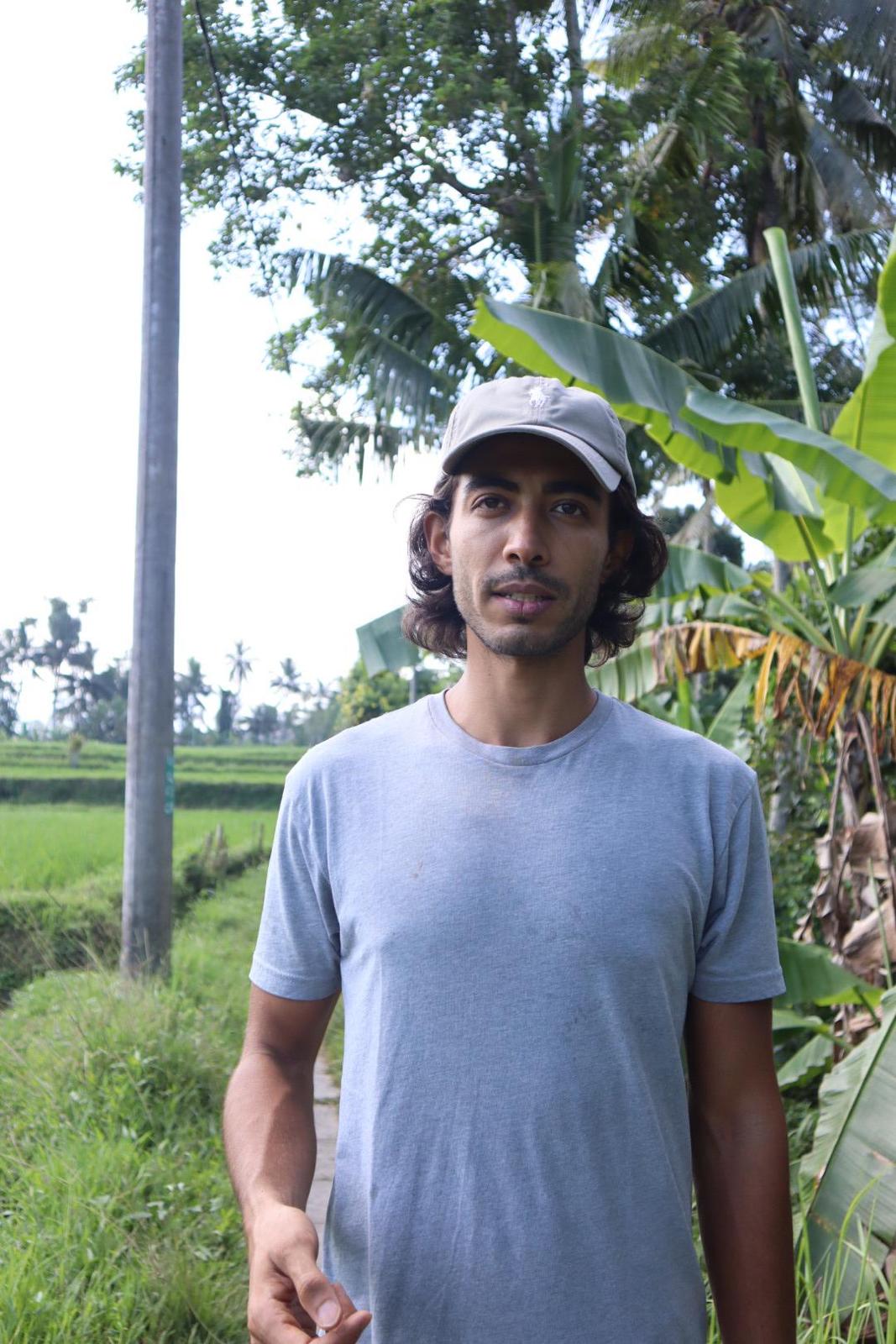
Neema Naeem-e

Neema Naeem-e.

Neema Naeem-e is a Naturalist Engineer building a generational food forest in Central America and working with English-speaking landowners across the region, primarily in Nicaragua and Costa Rica, who have bought land and do not know where to begin.

He learned this sequence by getting it wrong first: scattered plantings nobody could find, trees lost to enthusiastic machetes, structures he later had to take down. What all of it cost was time, which is the one input nobody can deliver to your gate.

His mission is straightforward. Turn degraded and abandoned land into low-maintenance, high-yield food forests that feed families for generations, using a food-first approach built on perennials, fruit tree succession and layered design, so the property becomes more freeing rather than more demanding.

The Last Word

Picture the first anniversary. Water is dependable enough that the young system does not survive on prayer. Materials are dry and secure. Two people know the valves, the markers and the section of road that washes. The boundary is thickening into something you cannot see through anymore. The nursery is already loaded for the next rains. Something on the property is feeding you.

And you can leave for a few weeks and come back to find the land still moving without you.

Start the clock

You bought land.
Now build the sequence.
Start the clock.

The canopy can already be growing while the house is still a drawing.

Yes! Rush me a copy — $20
30-day refund · Ebook only · Instant download